Friday, June 22, 2007

Marinara Amended

by Brian
This is not a full Recipe Friday today because (1) I don't have the time or inclination to write out a whole recipe and (2) I've been wanting to revisit one of my old recipes anyway.

A long while ago I posted the recipe to a good marinara sauce. Since then I've tweaked it a little to make it a great marinara sauce. So next time you want to make a sauce, follow that recipe, but with the following revisions:
  • Don't even bother with green onions. Use a real onion. And use a whole one, not just a half.
  • Add the sugar earlier: pour it over the onions when they are sautéeing in the oil. The idea is that it will bring out their sugars and sort of half-caramelize them (although you are not using that much sugar, and no butter).
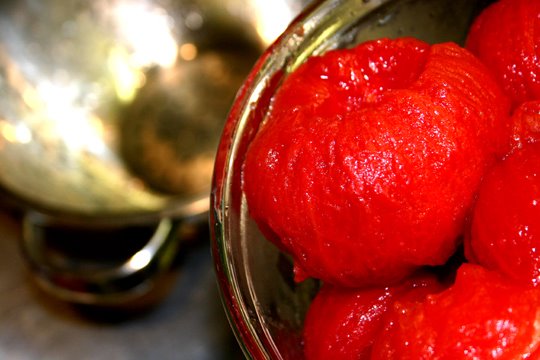
  • Rather than cutting up the whole tomatoes, squeeze them in your hands until they are mashed up. This will require pouring the contents of the can into a bowl, because you probably can't fit your fists into the can. Remember to wash up first.
  • When you add the tomatoes, also add a six-ounce can of tomato paste. This will make the sauce thicker.
I'm really hungry right now. I want this sauce to spring spontaneously from the computer screen and feed me. But that would never happen. Darn reality.

Labels: , ,

Monday, January 22, 2007

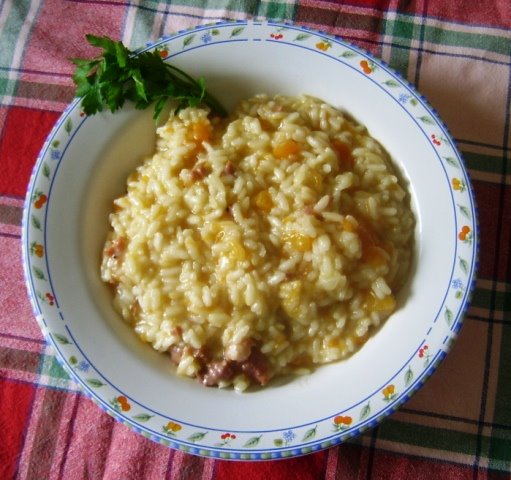
Ratso Risotto

by Brian

I know, I know, it sounds so Italian and restauranty. Except for the Ratso part, which is optional. But the truth is, if you can make pasta, you can make risotto. In fact, apparently in Northern Italy, from whence my college roommate's ancestors hailed, they prefer risotto to the traditional Southern pasta. What is risotto? It's basically a creamy sort of rice. And if you want to make it quick, it's insanely easy.

You'll need:
  • 2/3 cup arborio rice (This is a round, white, Italian rice you can find in any market that has a selection of rices, which is just about any market. You can do risotto with other sorts of rice, but some folks will tell you that's not really risotto. If you want to do it right, get the arborio.)
  • 1/2 tbsp butter
  • 1/2 tbsp olive oil
  • 3 green onions
  • 1 clove of garlic
  • 2 cups of water
  • 2 packets of chicken bouillon granules
  • 2 tbsp store-bought grated parmesan or 1/4 cup fresh parmesan that you grated yourself

You'll also need to use:
  • Measuring cups and spoons
  • A large sauce pan with a lid
  • Knives
  • A cutting board
  • A spatula
  • A stove

To get started, clean the onions and garlic. Cut off the white ends of the onions and slice the green stalks as thinly as possible into little rings. Peel off the paper from the garlic, cut the ends off, and dice it into pieces as small as possible. Other fun things to do with garlic: (1) if you've got a garlic press, stick in it and smash it through; (2) lay it flat on the cutting board and mash it to bits by pressing the flat side of the knife down on top of it. Don't hurt yourself.

Heat the butter and oil in the sauce pan over medium-high heat. In a pinch, you could use just butter or just oil, but the butter adds a creamy taste and the oil keeps the butter from burning, so they work best in tandem. When it is melted, add the sliced onion and diced garlic. Fry those, stirring them with your spatula, until they are tender but not brown. If they start to go brown, you're going a little too far.

Add the rice. Stir the rice around with the vegetables, butter, and oil for a couple minutes, but once again, if it starts to go brown, stop.

Add the water and bouillon. If all you've got are the cubes rather than the packets of granules, you should heat the cubes in the water separately until they break down and make broth. Otherwise, you can add them both at the same time. When you add the water, the pan should be hot enough that it sort of flash-sizzles for a couple seconds until the water cools it down. Now turn the heat up to high until the water starts to boil. Then, smack the lid on, turn the heat down to low, and simmer the risotto for twenty minutes. Don't remove the lid during that twenty minutes! If you do, two things could happen: One, seeing the risotto cooking process could put you into shock and you would simply pass out. Or two, it could create a time paradox, the results of which could start a chain reaction that would unravel the very fabric of the space-time continuum and destroy the entire universe!

When the twenty minutes are up, remove the pan from the heat and take off the lid. It should look like creamy rice, which means a little liquidy. If there's a tad too much liquid, you can cook it over low heat for a couple minutes, stirring, with the lid off to evaporate some water. If there's too little liquid, you could just add a little water. Add your parmesan cheese and stir it all up. Voila!

The risotto you just made is basically a plain risotto. Like pasta, risotto can come in all sorts of variations. You can add various vegetables or meats for variety. If you want to add chicken, sausage, or beef, cook it first in small pieces (as in, cut the chicken into the size of pieces you'd like in a salad and then cook it, or just brown ground beef like you would if you were making sloppy joes). If you're going to add vegetables, you can either do it at the start, along with the onion and garlic (which is best for hard vegetables, like celery or carrots), or at the end, either when it is done cooking or a couple minutes before that point (which is best for softer vegetables, like tomatoes).

Labels: ,

Your Basic Marinara Sauce

by Brian

I know how incredibly easy it is to go buy a jar of Prego and serve that with your spaghetti, maybe even throwing it on the stove and adding some spices and various other things, but you still can’t call that sauce your own. You can actually claim this sauce is “from scratch,” and it tastes better than that other stuff to boot.
You’ll need the following potent edibles:

* Four green onions (or half a regular onion)
* Five cloves of garlic
* 1/4 cup extra virgin olive oil (make sure they put that one extra virgin in there)
* 2 – 28 oz. cans whole, peeled tomatoes (or diced tomatoes)
* 2 tablespoons lemon juice
* 1/2 teaspoon sugar
* Some basil, oregano, and parsley

You’ll also need these apparatuses:

* Cutting board
* Sharp knife
* Garlic press, if you got it
* Can opener
* Kitchen scissors
* Large sauce pan (3 quart)
* Measuring cups and spoons
* Skillet
* Stove

Start, as always, but cutting things with knives:

* Wash the green onions. Cut off the white ends and discard them, and then slice the green stalks into hundreds of little thin rings. If you are using a regular white or yellow or red onion, cut it in half, cut off the nasty knob at the end, and chop it up into bite-size morsels.
* Wash and peel (peel and wash?) the garlic, cutting off the tiny nasty ends. If you have a garlic press, push the cloves through it onto your pile of chopped onion. If you don’t, just dice the garlic with the knife into really tiny pieces.
* Open the two cans of tomatoes. If they are diced in the can, stop there. If they are whole, you have to cut them up into smaller pieces. The easier way to do this is with kitchen scissors. Jab the sharp end of the scissors down into the tomatoes and cut, cut, cut. Try to make sure you get all the big pieces.

To the stove!

* Pour the 1/4 cup olive oil into the large sauce pan, and turn the heat up to medium-high. Let the oil heat for a minute or two before adding the onions and garlic.
* Sautee the onions and garlic in the hot oil for a couple minutes until everything is tender. If things start to turn brown, you’ve gone a little too far.
* Now add the tomatoes and stir everything up. Add the lemon juice and sugar and stir things up some more.
* Now add the herbs. How much to add is really subjective. Everything combined equaling 1/3 of a cup, especially if they are dried and crushed herbs rather than fresh, is probably too much. A teaspoon of each is probably too little. Just add whatever makes you feel comfortable.
* Reduce the heat to medium-low, or low, or whatever temperature, after simmering for a few minutes, is enough to make the sauce bubble a bit but not spray all over the place. Let the sauce simmer like this for about thirty minutes, which should be plenty of time to boil water and cook whatever pasta you are serving it with. Leave the sauce uncovered so some of the liquid boils off and it thickens.

Here’s a trick you can use when the pasta is finally cooked and drained:
Spoon several ladles of the sauce into a large skillet over high heat. Then add the pasta and toss it with the sauce for just a minute or two. This makes the pasta taste seven times better for several reasons:

1. The pasta becomes infused with the flavors of the sauce.
2. It prevents the pasta from sticking together.
3. Various other reasons I haven’t thought of yet.

Voila! Another great thing about this recipe is that you can create lots of different variations on the sauce. Add mushrooms if you like mushrooms or peppers if you like peppers. Brown some ground beef and throw that in for a meat sauce. Grill and cut up some sausage to toss in if you’re into that sort of thing. The possibilities, they tell me, do indeed have an end, but it’s so far down the line you wouldn’t notice.

Labels: , ,